Devonian Period
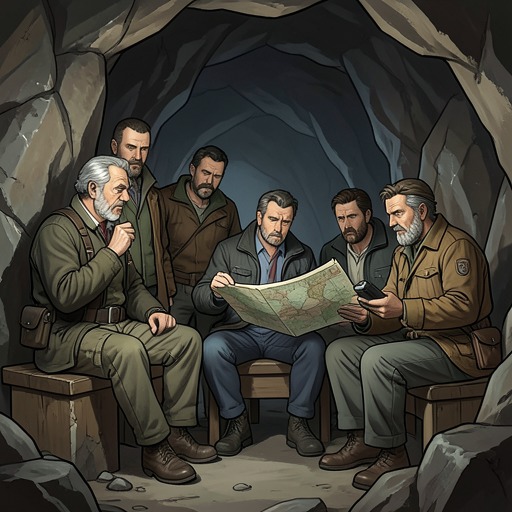
A Journey to the Centre of the EarthThe Devonian Period enters the narrative not as a remote date in a chronology but as a layer of rock crowded with evidence of an earlier world. As the travelers pass through its fossil-bearing strata, the narrator reads changes in stone and animal remains as a visible ascent through the history of life, even while Professor Hardwigg presses on with the descent.
Geological Setting
The travelers first recognize a transition in the rock: the shining lava gives way to living rock, and the narrator identifies the formation as Silurian. The route then exposes calcareous rock, old red sandstone, and marbles whose varied colors are marked with traces of primitive animals. The sequence turns the gallery into a record of successive geological ages, encountered directly rather than studied only in books.
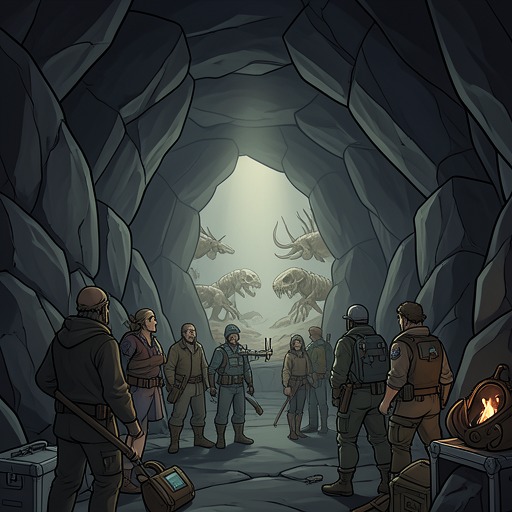
Among these formations, the narrator sees fossils of a more developed order than the rudimentary trilobites observed earlier. He describes one fish as the first form of the reptile, connecting the Devonian strata with a larger progression in animal life. The Devonian seas, he explains, supported vast numbers of these creatures, whose remains were deposited by the tens of thousands in newly formed rock.
Fossils and the Expedition’s Interpretation
The narrator treats the fossil succession as evidence that life is advancing through recognizable stages. In his reading, the more developed fossils mean that the travelers are ascending the scale of animal life, whose summit is humanity. This interpretation makes the Devonian remains more than geological specimens: they become signs that the underground route is carrying the expedition forward through natural history.
That reading sharpens the tension between the travelers’ observations and their direction of travel. The rock’s character remains transitional, and the path offers no clear upward course; at times it seems to descend. Yet the narrator’s fossils suggest a movement toward more recent forms of life. The geological evidence thus points one way while the expedition’s physical progress and Professor Hardwigg’s resolve point another.
Scientific Knowledge and Narrative Role
The Devonian references belong to the novel’s nineteenth-century effort to make deep geological time tangible through travel, strata, and fossil classification. The narrator presents the claims as the characters’ interpretation of what they see, not as a detached modern account of geology. His geological enthusiasm contrasts with Professor Hardwigg’s refusal to treat the fossils as a warning to stop; the same underground evidence that enriches the narrator’s understanding fails to turn the expedition back.
The period consequently serves both as setting and as an argument made through material traces. Fossils establish that the rocks preserve successive forms of life, while the travelers’ competing responses show how observation can acquire different meanings: for the narrator, it maps a history of increasing complexity; for the Professor, it does not outweigh the decision to proceed.